
Understanding the menstrual cycle
The menstrual cycle plays a vital role in fertility, so understanding it, cycle tracking and recognising the signs of ovulation is important when planning for pregnancy. For women experiencing difficulties conceiving, understanding the menstrual cycle also provides valuable insight into potential underlying issues and guides fertility specialists in recommending the most appropriate treatment options.
What is menstruation?
The menstrual cycle is the natural process a woman goes through to become fertile. Each month one of the ovaries releases an egg; it is at this time that the uterus prepares for pregnancy to occur. If the released egg isn’t fertilised, the lining of the uterus sheds through the vagina. This is a menstrual period. This cycle occurs monthly from puberty through menopause.
For many women, trying to conceive can be a challenging time. Learning to better understand your menstrual cycle and to recognise the signs of ovulation may help you feel more in control.
What are the menstrual cycle phases?
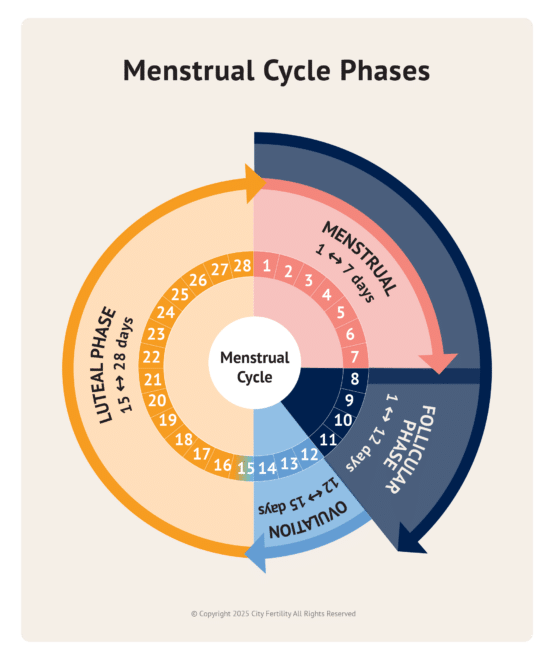
A typical menstrual cycle lasts between 25 and 35 days and is the process a woman’s body goes through in order to achieve a pregnancy. It is divided into two main parts, ovarian and uterine.
The ovarian cycle drives egg development, while the uterine cycle prepares the womb for pregnancy. Together, these cycles work in harmony each month to create the best possible environment for conception to occur.
Ovarian cycle phases
The ovarian cycle doesn’t have a menstruation phase and just has the follicular, ovulation and the luteal phase. Essentially it is the growth, maturation and release of an egg from a woman’s ovaries. It differs from the uterine cycle in that it occurs in the ovaries, not the uterus.
- Follicular phase: The follicular phase is the first phase of the menstrual cycle. It begins on the first day of your period and can last for up to 13 or 14 days. Fluctuations in your hormone levels cause the lining of the uterus to thicken and follicles form on the surface of the ovaries. Usually only one will mature into an egg.
- Ovulation cycle phase: Ovulation is when a mature egg is released from a woman’s ovaries. This usually happens once a month, approximately two weeks before your next period is due. It is more likely that you will successfully conceive if you have unprotected sex around the time of this ovulation cycle phase.
- Luteal phase: Following ovulation, the egg travels through your fallopian tubes to your uterus. During this time the lining in your uterus continues to thicken as it prepares itself for a pregnancy. If you successfully conceive, you won’t have your next period. If you don’t fall pregnant, you will menstruate as normal, and the menstrual cycle will begin again.
Uterine cycle phases
Just as it sounds, the uterine cycle takes place in the uterus and consists of menstruation and the proliferative and secretory phases. The menstrual cycle prepares the uterine wall to receive a fertilised egg.
- Menstruation (Your Period): Menstruation, or period, is the beginning of the uterine cycle. It’s the time during your cycle that the lining of your uterus, or endometrium, sheds through your vagina in the form of blood. It’s called a period and usually lasts between 3 and 7 days. This flow is usually a sign that pregnancy has not been achieved.
- Proliferative phase: The proliferative phase is the second stage of the cycle, when hormones cause the endometrial lining in the uterus to grow or proliferate. As the ovarian follicles start to mature, oestradiol is released, causing the formation of a new layer of the endometrium or uterus lining.
- Secretory phase: The secretory phase, the final one of the uterine cycles, corresponds with the luteal phase of the ovarian cycle. During the secretory phase, the follicle that releases the egg produces the hormone progesterone, which enables the endometrium to be receptive to the implantation of the developing embryo and support early pregnancy. Mood and behaviour may be affected during this period, with mild to severe mood swings possible. The change in hormone levels may contribute to increased feelings of empathy or depression.
Maximising Conception: Your Fertile Window
Your “fertile window” refers to the days leading up to ovulation which are the most fertile in your menstrual cycle. In a This corresponds with days 11 – 16 in a 28-day cycle with a 14-day luteal phase. During this time, the egg is moving down the fallopian tube, waiting to be fertilised.
To boost your chance of conception, it’s best to have unprotected sex every two days around the time of ovulation. A woman who has a 28-day cycle and ovulates on day 14 should have sex on days 9, 11, 13 and 14 and so on to increase her chances of pregnancy. Fresh sperm is needed in the fallopian tubes to meet the egg, so regular sex before and during ovulation is encouraged.
It is important to know your ovulation day and “fertile window” if you’re trying to conceive as you have a greater chance of conceiving if you time sex one to three days before ovulation or every two days around it.
How long does the menstrual cycle last?
The average menstrual cycle length is somewhere between 25–35 days and begins on the first day of your ‘period’ – the day you begin to bleed. Cycle lengths may vary shorter or longer than this. The ‘period’ usually lasts between 3–7 days. Period pain can occur in the first few days of your cycle as hormones are causing the womb (uterus) to actively shed the lining or endometrium.
Symptoms of menstruation
In the days leading up to and during a period, women can experience a variety of menstruation symptoms. These relate to hormonal fluctuations that tell the body to prepare for pregnancy and a part of a natural menstrual cycle. These can include:
- Cramping in the lower abdomen
- Bloating or a feeling of fullness
- Mood changes
- Breast tenderness
- Headaches
- Various levels of bleeding, from bright red to dark brown
Taking a pregnancy test after your menstrual cycle
Home ovulation kits are good predictors and you can buy these in pharmacies and selected supermarkets. The kits can help you accurately determine when you’re most likely to become pregnant. They are a simple urine test, and are able to detect the amount of the hormone needed for the release of an egg. This will peak in the urine 24-36 hours before the egg is released. With each menstrual cycle a normal, healthy, fertile couple has about a 20% chance of falling pregnant. On average, 60% fall pregnant after 6 months of trying to conceive and 80% within a year.
If you would like more information about the causes of female infertility our website has many resources including:
With the above in mind, if you’re struggling to conceive, please reach out. You can call our Fertility Advice Centre team, make an appointment with one of our fertility specialists or take up a free fertility health consultation with a City Fertility GP. We can support and guide you to grow your family.
To learn more, please read our fact sheet: Understanding your menstrual cycle.
FAQs about the Menstrual Cycle
Assuming the woman has a 28-day cycle, her time of ovulation will be around day 14 of her cycle. Ovulation is the release of an egg from the ovary and is the fertile time of a woman’s menstrual cycle.
If your period is regular and the length is the same each month, you can calculate ovulation by counting back 14 days from the end of the cycle. Therefore, if your cycle is 32 days then ovulation will occur around day 18, or if your cycle is 28 days long then ovulation will occur on or about day 14. Using a menstrual tracker can assist you in this process.
If your cycle is irregular and changes length month to month, it is much harder to calculate ovulation. Whilst irregular cycles are usually not dangerous, it is important to determine the reason for this and a fertility specialist can support you.
You may notice some changes during ovulation. The cervical mucus will change from being sparse, cloudy and dense to thin, clear and slippery. It is often described as having the appearance of raw egg white. This mucus is sperm friendly and allows the sperm to swim freely and last in this environment. Some women may also experience slight pain during ovulation and may also notice some abdominal bloating and breast tenderness. However, some women may not notice any changes in their physiology. Meanwhile, the lining of the uterus is prepared to receive a possible fertilised egg.
If you have an irregular cycle, ovulation induction may help. It is a fertility treatment that uses medications to cause or regulate ovulation or increase the number of eggs produced during a cycle, to increase the opportunity for pregnancy.
The days leading up to the release of an egg from your ovaries (ovulation) are the ones in your menstrual cycle. This corresponds with days 11 – 16 in a 28-day cycle with a 14-day luteal phase. During this time, the egg is moving down the fallopian tube, waiting to be fertilised.
You have a greater chance of conceiving if you have sex one to three days before ovulation or every two days around it. This means that sperm are ready and waiting for the egg when the woman ovulates. If you wait until after ovulation before you have sex, you probably will have missed the opportunity for conception and will need to wait until the next month.
An egg can survive for 24 hours after ovulation takes place, while sperm can survive and fertilise an egg for two to three days in the fallopian tubes. To learn more, visit our Fertility window page.
It’s unlikely that you will get pregnant during your period cycle and that is because your fertility window is still a few weeks away. That being said, it can happen, more so with women who have a shorter cycle, say every 21 to 24 days, as you will be ovulating earlier.
Request an appointment with one of our specialists.Make your appointment